
Research Trip Part 2: Fort Payne Historic Cabin Site
How 1830s chaos made the region ripe for vigilantism, and the cabin's role in the Trail of Tears.

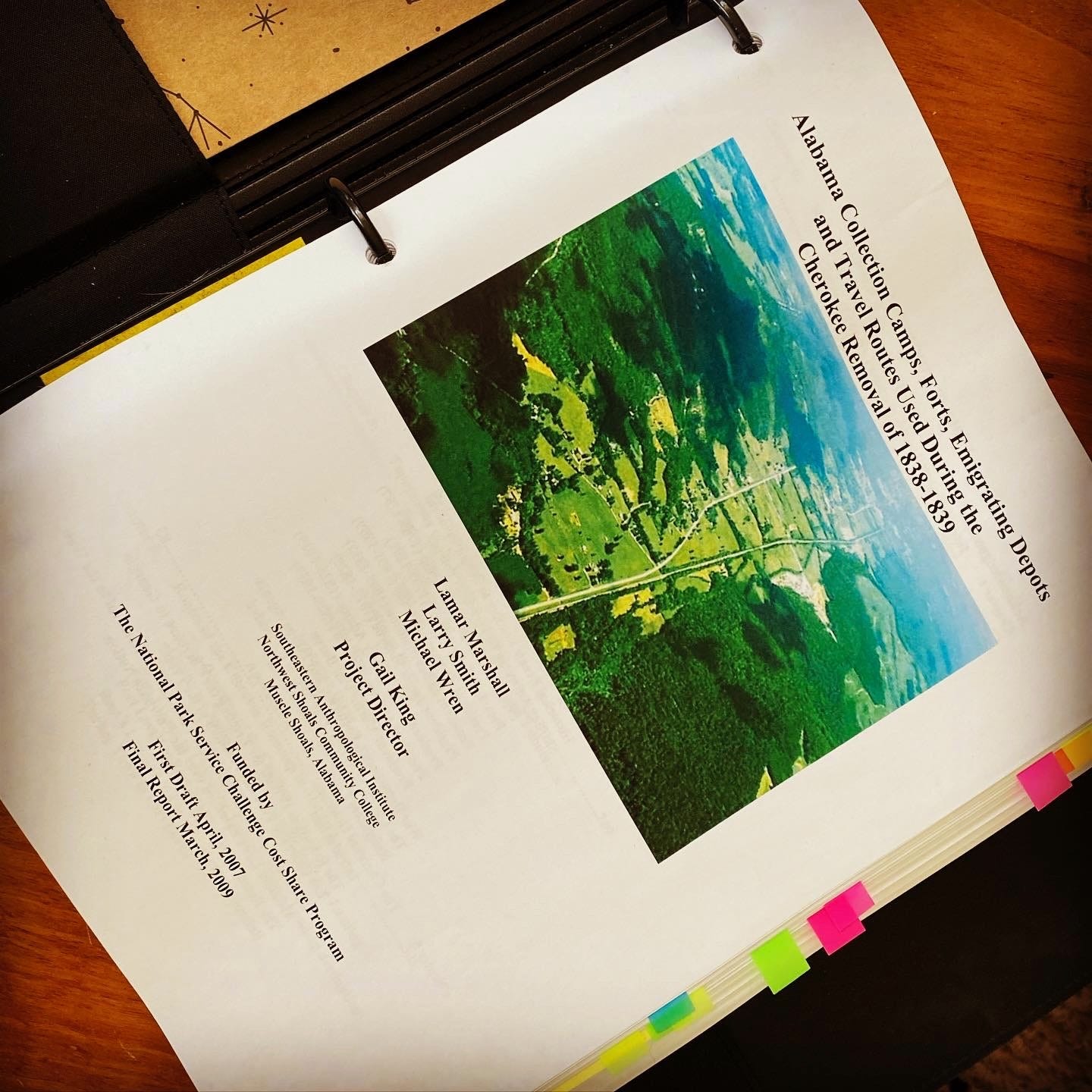
Once settled in the Bird House (see part 1), I commenced methodically consulting my giant binder that I brought on the plane all the way from home to Alabama. Poor Ryan was itching to get out the door, but here I was, checking my highlighted passages and looking at maps. I’m fairly certain he went outside and back a few times just to cross the threshold and see if the very act changed my readiness.
It did, actually. I gave up on the binder. It was all in my head anyway. But I didn’t want to leave it behind, so I hauled it around in the hamster car (“small SUV”) on our way to into Forte Payne to hunt for the cabin site.
You too can fill your mind with the giant report by visiting this PDF link. This document has archeological and historical info that can satisfy and horrify the curious mind in equal measure.
Setting the scene
Info in the document above, gleaned from many first-hand sources including letters and the Cherokee Phoenix newspaper, paints a picture of what life in the region looked like by the time the bulk of my novel (What Shadows Hide, on query now) starts. It shows that Thomas Miller’s family steps into a place ripe for vigilante activity, as was common in regions with this level of upheaval.
Here is an interesting excerpt from the document:
Alabama Laws Extended over the Cherokee Nation On February 25th, 1832 the Cherokee Phoenix published an article commenting on the extension of Alabama laws over the Cherokee and Creek Nations in Alabama. The law was blamed for hundreds of citizens of Alabama intruding on Indian lands. The article expressed the “wanton cruelty and oppression excised” over the Cherokees. Land and property were taken away, their rights and liberties were invaded, and lawless intruders were swarming in. The extension of Alabama laws over the Cherokee and Creek Nations attracted the lawless citizens of the adjoining states. “We understand that Will’s Valley is now filled up by intruders; a great many are joining their fences to those of the Cherokees, others take possession of farms which may happen to be lying some distance from the house of the owner, without asking his consent. Others have threatened to possess themselves of Ferries and Bridges belonging to Cherokees” (Cherokee Phoenix 1832: 2). Excerpts of the laws passed by the State of Alabama are shown below [in the document linked above] as printed in the Cherokee Phoenix issue of February 18, 1832.
That was in 1832. By the time Thomas’s family arrives deep in the woods in 1834, the depredations and squatting just outside are rampant. His family is really no better, since they are technically squatters, too. While most people came to farm, his family is running from something—he just doesn’t know what it is yet. Thus they retreat to the isolated woods where he meets the other characters.
Let’s jump ahead, though
Thomas’s most likely entry point to Alabama is further south near Centre and Turkey Town. Furthermore, their pocket of woods is about 25 miles from Fort Payne, so we don’t need to talk about the story much.
What I’m going to cover next is not the main plot force, but it does influence the characters’ lives.
Fort Payne Historic Cabin Site


The air here is somber, quiet. I’d say heavy, but that’s probably the humidity I’m not used to. Fort Payne Historic Cabin Site is thought to be commandeered as part of a holding center for the Trail of Tears. Cherokee from surrounding towns were forced from their homes and put here about three summer months before departing over a thousand miles west in October 1838.
In this general area there was a stockade, cabin, and dispersed encampments with soldiers at perimeter. Researchers suspect there were few actual walls to this holding center, so keeping nefarious outsiders away, and the frustrated captives in at the same time was no small feat.
With flour and bacon rations being foreign to their diet, sick season already looming, and most of the people lacking basic necessities, severe health issues cropped up quickly. Many people attempted to go home—if their homes were not destroyed or taken out from under them as they left. They were forced back to the stockade. Only people of high status were allowed to remain at home until processing and departure.
While excavations haven’t confirmed a hatch near the cabin, it is said a hatch existed down which they stuffed people to “hold” them. The entire stockade was dismantled a very short time after departure, so it is hard to say if this particular cabin was the one spoken of.
Let’s talk numbers
According to the 1835 census, 1,424 Cherokee resided in Alabama with 299 enslaved Blacks and 32 intermarried Whites. Slavery was something all three of my cultural accuracy readers/advisors wanted me to make note of. I don’t know the ratio of enslavers to enslaved overall, but by reading the census I see that certain families held a large number while others had none.
The signs at the cabin site gloss over specifics for the sake of brevity, so here are more detailed stats:
800 people stayed around the stockade through most of summer, their numbers falling and rising. Many left in groups of roughly 200-300 folks. The remaining people joined others eight miles below before setting out.
Along the way people abandoned, switched groups, or gained more members for an average 1190 on route with John Benge in the lead.
At least 33 people from this detachment died by the time they arrived at their destination, and it is said that about 4,000 of the 16,000 total persons removed perished along the 1,200 (depending on where they started from) mile march.
The Benge detachment arrived in what is now Cherokee Nation in Oklahoma, January 1839. Once there, more trials began while political factions demanded justice from each other, or struggled to keep control of already-established community order while newcomers flooded in.
Willstown and the mission are very close to Fort Payne, so people from that area would have been held here, but I’m going to save Willstown for a different topic.
In summary
This site was painfully necessary to research, but thanks to the bodies of work people have put together, I learned more about the region than I thought I would. I also got to work closely with one of my cultural accuracy readers on this. The fact that they had to stop occasionally to recenter brought home how much written work affects people, how hard this person’s job is, and the responsibility we all have to do right by our readers.
Here are some quick links related to the Fort Payne site:
Check references to see primary sources, and compare them to each other.
As always, if you’re wanting an accurate and all-encompassing approach, seek out literature from Cherokee historians such as Rachel Caroline Eaton, Julie L. Reed, and Robert J. Conley. Theda Perdue is also a huge name in this kind of research.
Alabama Collection Camps, Forts, Emigrating Depots and Travel Routes Used During the Cherokee Removal of 1838-1839: https://www.nps.gov/trte/learn/historyculture/upload/Alabama-Collections-Camps-Forts-Depots-and-Routes-508.pdf?fbclid=IwAR0GUmzj8b1DoEOzutzJSKfdjHq1P3LPr9NNKgZiLE5ii2nDYumih978OWQ
Landmarks of Dekalb: https://www.landmarksdekalbal.org/preserving-dekalb-county-alabama-landmarks/the-old-cabin-excavation/
Historical Marker Database: https://www.hmdb.org/m.asp?m=100286
See also this interactive map of Trail of Tears route: https://www.nps.gov/trte/planyourvisit/places-to-go-in-alabama.htm
If you haven’t already, please consider a free subscription to support my work and receive a free short story.